In the autumn of 1992 I was a hyperconscious 34-year-old who still got excited to ride my bike 11 miles each way to work. I woke at a quarter after four, made my coffee, and by 4:45 AM I was rolling down the dark, spooky-silent Ballona Creek bike path toward my front-desk job at Bear Stearns in Century City.
Then came the penultimate mile of the commute: the Motor Avenue climb, off the seat, all the way up to Pico Boulevard across from the MGM Studios. That one-mile power climb kicked my butt every single morning.
The question I couldn't shake
Every weekday at 5:22, pushing down hard on every quad-burning pedal stroke, I had the same vision:
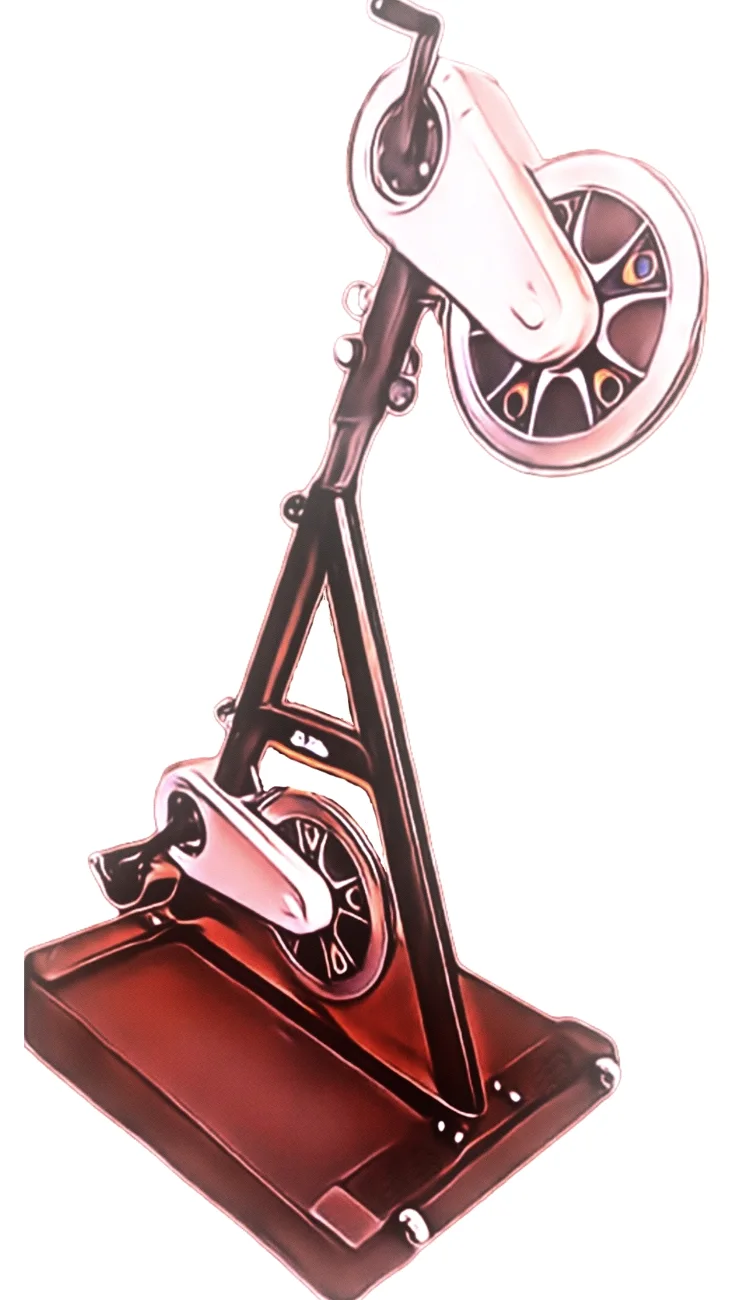
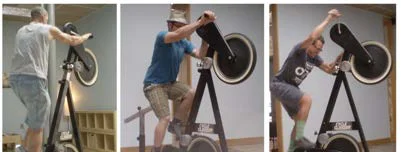
"WHY isn't there some kind of stationary workout bike that is vertically disposed, so that it also works the upper body? As if someone were climb-pedaling up and over a steep hill, like a serious switchback up the Pyrenees, and pulling themselves up and off the seat, into the sky?"
The upper and lower body move independently of one another. So why not a flywheel for each one? Two flywheels at the same RPMs, with resistance tailored to your body, would make for a comfortable, synergistic rhythm with a full, steady range of motion.
It seemed so obvious.
Witnessed and welded
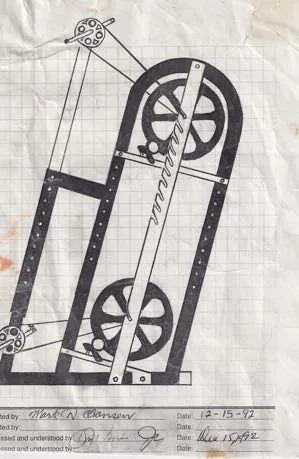
On December 15, 1992, I made my first crude drawing. I walked a half-block up the street to have my neighbor sign it as a witness, and the gregarious bearded fellow who answered her door was all-too-happy to autograph it.
A metal fabricator in LA agreed to build the frame and deliver it for the obscenely low price of $450. The 400-pound monstrosity (3.5" square tubing, 3/16" wall) sat next to the dumpster in my apartment's parking garage for nearly three months. A neighbor said it looked like a drill press.
"Just wait until I put two 20-inch BMX wheels inside that frame," I told him. "Then you might get it."
The patent application was filed in mid-1993. The utility patent was granted in August 1994. The climb had begun.
Adapted from Marko's eBook, The World's Most Disrespected Inventor.