
Two flywheels. One rockin' good climb.
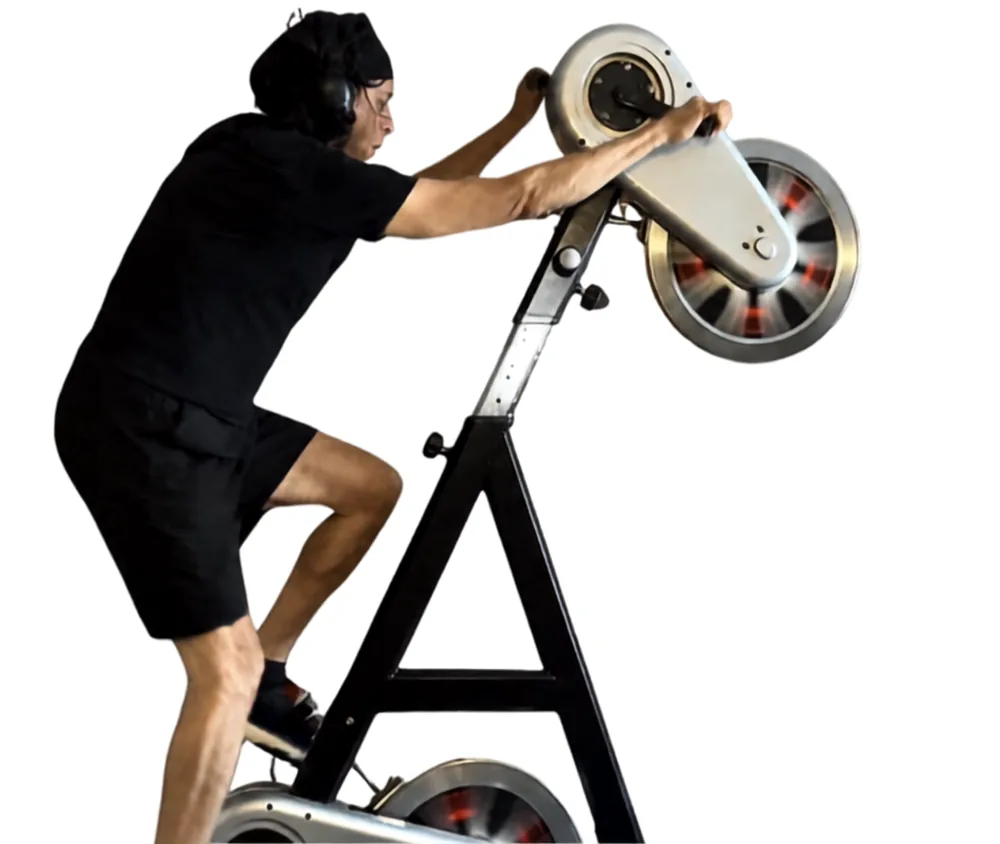
Your upper and lower body move independently, so why should they share one flywheel? The ClimbROCKER gives each its own, then adds spring-loaded oscillation that helps you quickly find your synergistic rhythm.
Climb up and into the sky.
Dual flywheels
One upper flywheel for the arms, one lower flywheel for the legs, each spinning on its own with its own resistance.
Tailored resistance
Set each flywheel to your body type and find a comfortable, synergistic rhythm with a full range of motion.
Spring-loaded oscillation
A front pivot and rear automotive-grade coil springs add a rhythmic, angled oscillation to every stroke. The sweet spot: 5½-inch springs.
Adjustable height
Raise or lower the upper flywheel with a single knob. The higher it goes, the easier the climb, thanks to the "pull-down" factor.
Ten things most people don't know about CycleClimbing
- Reverse upper flywheel rotation works the pecs.
- Forward upper flywheel rotation works the lats.
- Seated close to the upper flywheel (forward rotation) works the arms. More push.
- Seated far behind the upper flywheel (forward rotation) works the lats. More pull.
- Holding the outside of the tapered grip pumps up the forearms.
- Reverse handgrip (palms facing you) with forward upper rotation works the triceps.
- Reverse handgrip with reverse upper rotation works the biceps.
- Not using the seat is easier than using the seat, thanks to dual-flywheel inertia.
- The higher the flywheel, the easier the workout: the "pull-down" factor.
- A 20-minute workout at 60 RPM average = 1,200 rotary reps with resistance.
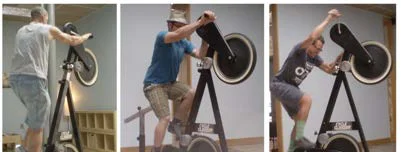

34 years of poor man's R&D
No engineering degree. No gym membership. Just a plant-based ADHD motor and a total refusal to quit.
- 1992
The sketch
On December 15, Marko draws a "big ugly yet fully-functional" machine and has a neighbor sign it as witness. A 400-pound frame gets welded for $450.
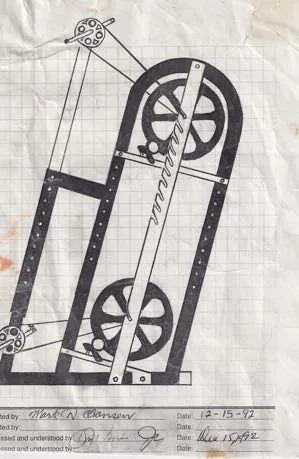
The original witnessed drawing, December 1992. - 1994
Patent #1
After leaving LA for his hometown of Tucson to finish the prototype, the first US utility patent is granted in August 1994.
- '90s
Gyroglide & the Bowflex years
Trade shows, a licensing agreement at last, the "Ladies of Bowflex," and a cancellation that sent him back to square one.
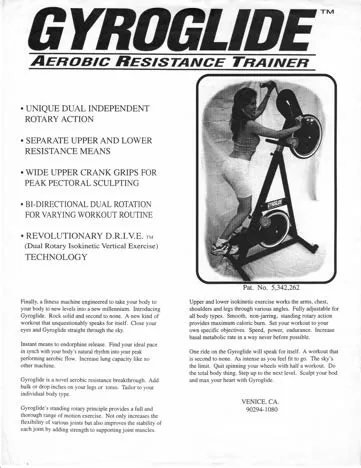
An early sales flyer, back when it was the Gyroglide. - 2000s
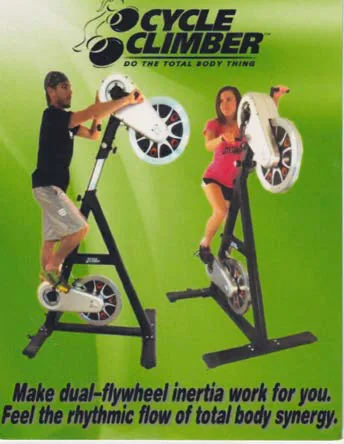
The CycleClimber
A new name, a new frame, and the hunt for the CycleClimber postcard models. "Do the total body thing."
- 2010
Proof on the scale
52 pounds lost in under five months on the CycleClimber, five weeks ahead of schedule.
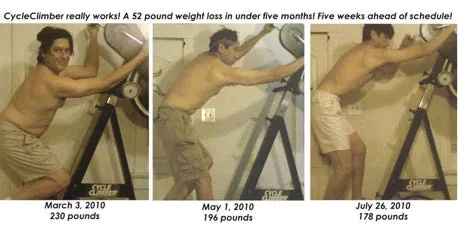
March 3: 230 lbs. May 1: 196 lbs. July 26: 178 lbs. - 2020
Eureka #3: the bounce
Inspired by old footage shot in a pickup with worn-out shocks, Marko bolts a pair of coil springs onto the back of the frame on December 1. Game-changer.
- 2023
Patent #2
Notice of Allowance in September, and a second US utility patent in December, over 29 years after the first.
- 2026
ClimbROCKER
A fresh name for a machine that's still looking for its perfect partner. Licensees, investors, trainers and dreamers welcome.